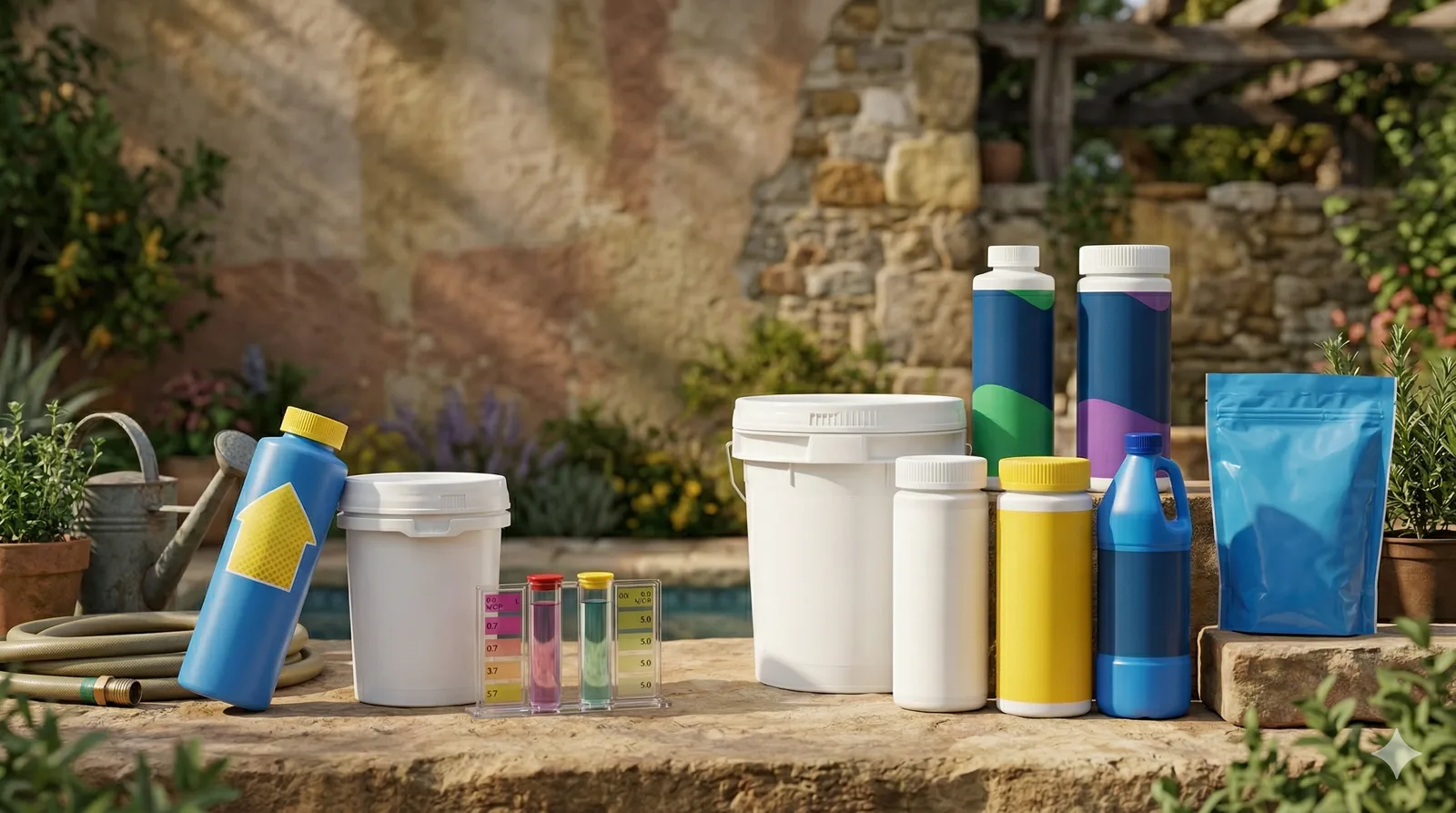

The core five chemicals
A well-maintained pool runs on five categories of chemicals. Everything else is either situational or a duplicate product in different packaging.
Kills bacteria and algae. You need two forms: slow-dissolving tablets for daily maintenance and fast-acting shock for weekly oxidizing. They work together, not interchangeably.
Keeps water in the 7.4 to 7.6 range where chlorine works best. Both pH Up and pH Down are needed — which you use depends on your water source and bather load.
Stabilizes pH so it doesn't swing wildly after rain or heavy use. Fix alkalinity before touching pH, or your pH adjustments won't hold.
Needed if your fill water is naturally soft. Low calcium water is corrosive and will etch plaster and attack metal fittings. High calcium water deposits scale. Most municipal water is in range — test before buying.
Protects chlorine from UV degradation in outdoor pools. Add once at season start to bring CYA to 30 to 50 ppm. Trichlor tablets add small amounts with each use, so monitor levels and don't over-stabilize.
What you can skip
Algaecide is useful as a preventative but isn't necessary if chlorine levels are consistent. Pool clarifier helps clear cloudy water after a chemistry correction but isn't part of regular maintenance. Metal sequestrants are only needed if your fill water contains iron or copper. Enzyme treatments help break down organics in pools with heavy bather load. None of these are essential for a well-maintained pool.
Buying in bulk vs. season packs
A 50-lb bucket of trichlor tablets costs less per pound than smaller containers and typically covers one full season for a 20,000-gallon pool. Shock is also cheaper bought in case quantities. The main caveat is storage — pool chemicals need to be kept dry, in a cool location, and never stored near each other. Trichlor and cal-hypo stored together is a fire hazard.