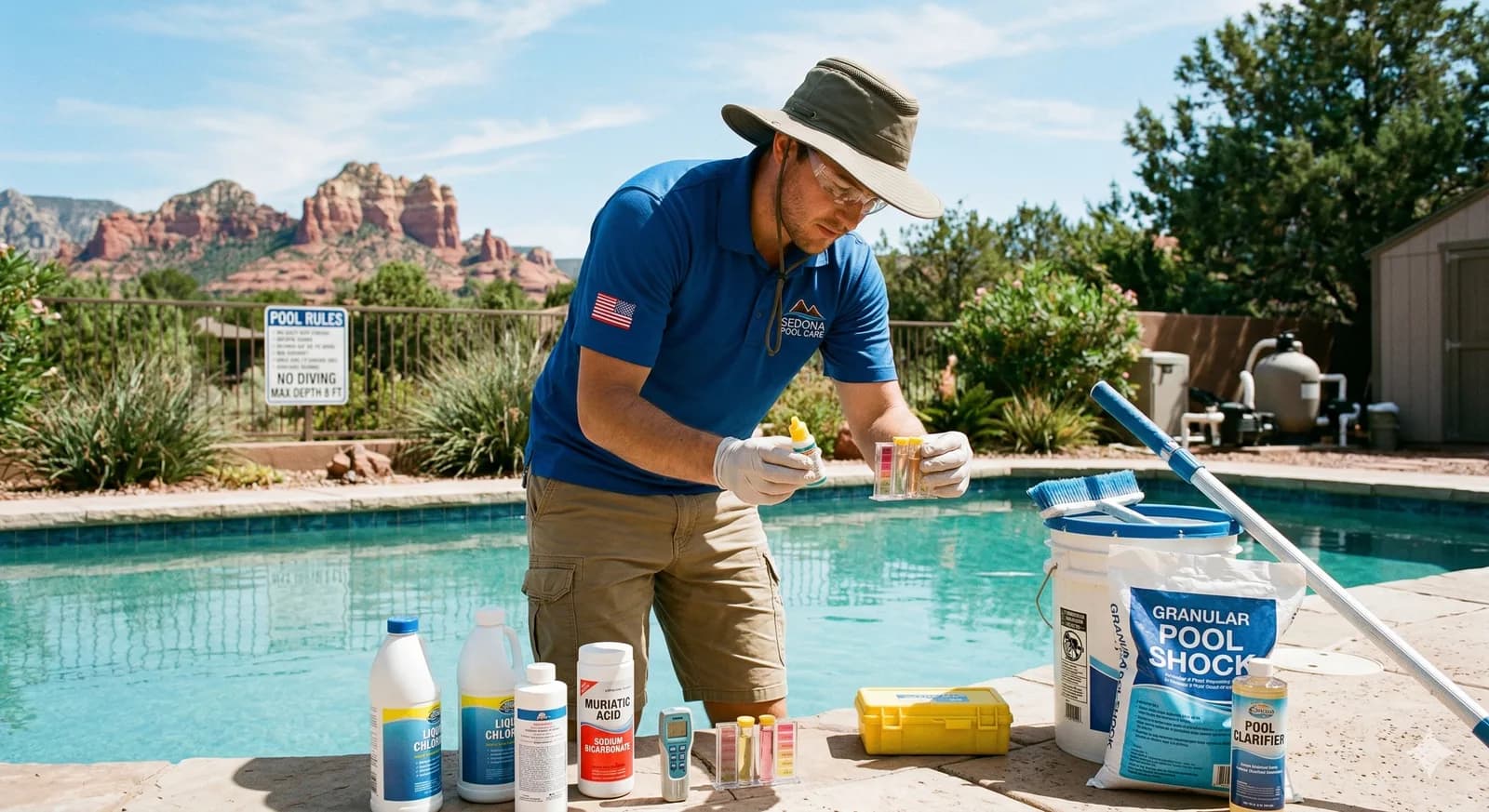
Target ranges at a glance
| Parameter | Ideal range | Too low | Too high |
|---|---|---|---|
| pH | 7.4 – 7.6 | Corrosive, eye irritation | Cloudy water, scale, chlorine loss |
| Total alkalinity | 80 – 120 ppm | pH swings wildly | pH hard to lower, cloudy water |
| Free chlorine | 2 – 4 ppm | Algae and bacteria grow | Eye/skin irritation, bleached liners |
| Calcium hardness | 200 – 400 ppm | Water etches plaster and metal | Cloudy water, scale on surfaces |
| Cyanuric acid | 30 – 50 ppm | Chlorine burns off quickly | Chlorine lock — ineffective treatment |
Step 1: Know your pool volume
Every chemical dose is calculated per 10,000 gallons. Before you add anything, you need an accurate gallon count. Use the pool volume calculator if you haven't already, and write the number somewhere permanent — on a piece of tape on the filter housing works well. An incorrect volume means every dose you calculate will be off.
Step 2: Test the water
Test all five parameters before adding anything: pH, total alkalinity, free chlorine, calcium hardness, and cyanuric acid. For a complete picture, use a drop-based test kit rather than strips. Strips read pH and chlorine fine but are less reliable for alkalinity and calcium.
Take your sample from elbow depth in the middle of the pool, away from return jets. Surface water and water near jets give inaccurate readings.
Step 3: Adjust total alkalinity first
Total alkalinity (TA) is the buffer that stabilizes pH. If TA is out of range, your pH will be impossible to hold steady regardless of what you add. Fix TA before touching pH.
- TA too low (under 80 ppm): Add sodium bicarbonate (baking soda). About 1.5 lbs per 10,000 gallons raises TA by roughly 10 ppm. Add, wait 6 hours, retest.
- TA too high (over 120 ppm): Add muriatic acid or sodium bisulfate. Add in small amounts — it's easier to add more than to reverse an overshot. Broadcast it across the deep end with the pump running.
Step 4: Adjust pH
With alkalinity in range, pH becomes much more stable and easier to adjust. Target 7.4 to 7.6. Below 7.2, the water becomes corrosive — it will irritate eyes and can damage equipment. Above 7.8, chlorine loses effectiveness and scale begins to form.
- pH too low: Add sodium carbonate (soda ash). About 6 oz per 10,000 gallons raises pH by 0.2 points.
- pH too high: Add muriatic acid or dry acid. Pour slowly around the perimeter of the pool with the pump running.
Step 5: Check calcium hardness
Calcium hardness affects the water's tendency to corrode or scale. Low calcium water is aggressive — it will pull calcium out of plaster, grout, and metal fittings to satisfy itself. High calcium water deposits scale on surfaces and equipment.
- Hardness too low: Add calcium chloride. Pre-dissolve in a bucket of water before adding to the pool — it generates heat when dissolving and can crack plaster if added dry.
- Hardness too high: The only real fix is diluting with fresh water. Partial draining and refilling is effective for severe cases.
Step 6: Maintain chlorine and cyanuric acid
Free chlorine should sit between 2 and 4 ppm during regular maintenance. If you're using stabilized chlorine tablets (trichlor or dichlor), each tablet adds a small amount of cyanuric acid to the water over time. Test CYA monthly and don't let it climb above 80 ppm or chlorine will lose effectiveness even at normal levels.
Shock weekly during peak season — especially after heavy use or rain — to oxidize combined chlorine (chloramines) that cause the "pool smell" and eye irritation. Use cal-hypo shock for pools with CYA already at or near the high end, since it doesn't add more stabilizer.