Opening a pool is straightforward when you do it in the right order. The chemistry steps trip people up most — adding chemicals out of sequence, or guessing at doses without knowing the pool volume. Before you start, use the pool volume calculator to get your exact gallon count. Every chemical dose in this guide is calculated per 10,000 gallons; you'll need your actual volume to scale the numbers correctly.
Open early, not late
Algae starts growing around 60°F. Opening two to three weeks before you plan to swim, when water is still cold, means less algae to fight and a cleaner startup. Waiting until the water is already warm makes the chemistry work harder.
Remove and clean the cover
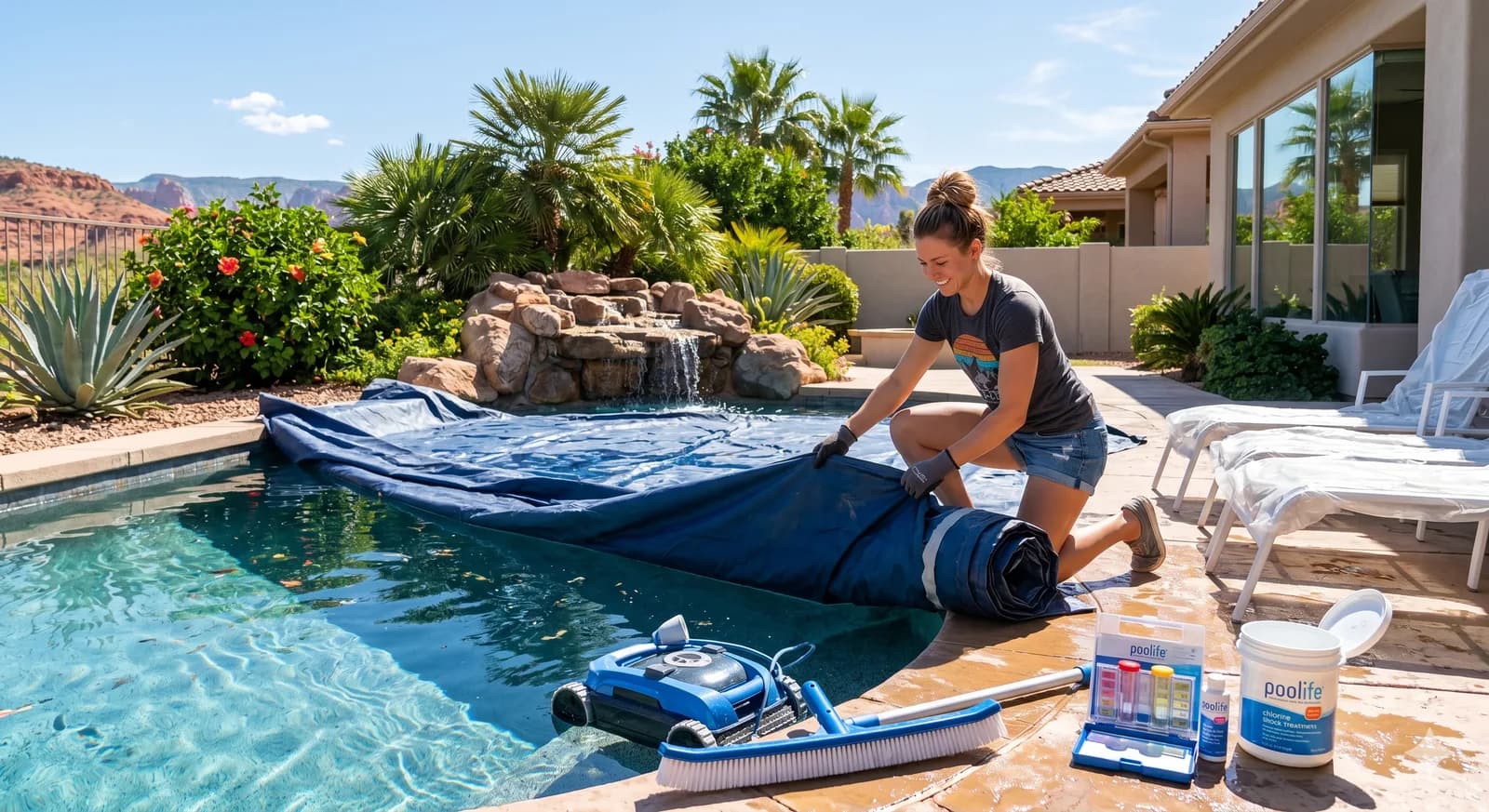
Pump standing water off the top of the cover before you remove it — dragging a cover loaded with water dumps all of it into the pool. A submersible cover pump handles this in 20 to 30 minutes. Once the surface water is gone, remove the cover with a second person if possible. A large winter cover full of debris is difficult to handle alone without dumping debris into the pool.
Lay the cover out flat on the deck or lawn. Hose it off thoroughly, scrub any algae spots with a pool brush and a mild cleaner, then let it dry completely before folding and storing it. A cover stored wet grows mold and deteriorates faster. Fold it loosely — tight folds crease and crack the material over time.
Safety covers
Mesh safety covers let rainwater through, so there's no standing water to pump off. Remove by unclipping anchors around the perimeter — start at one end and work toward the other.
Solid winter covers
Pump the top dry first, then remove. Check the water underneath — solid covers often create a dark, warm environment that encourages algae if they weren't sealed well.
Remove winterizing plugs and reinstall equipment
Pull the rubber winterizing plugs from the skimmer(s), return jets, and any other fittings you plugged in the fall. Keep them together — you'll need them again at closing. Reinstall the drain plugs in the pump, filter, and heater. These are the small plugs you removed to drain water from the equipment over winter; putting them back is easy to forget and will cause leaks the moment you turn the pump on.
Reinstall the pump basket, filter components, and any equipment you removed for winter storage. Reconnect pressure gauges, valves, and chemical feeders. If your heater has a bypass valve, set it to normal operation.
Check all O-rings and gaskets on the pump lid, filter, and valves before starting the system. Winter temperature swings dry out rubber components. A cracked pump lid O-ring will pull air into the system and prevent the pump from priming — a common startup headache that a $5 O-ring prevents.
Top off the water level
The pool needs to be at the proper operating level before you run the pump — water should reach the midpoint of the skimmer opening. If the level is low from evaporation or splash-out over winter, add water now with a garden hose.
If you used antifreeze in the plumbing lines over winter, the water from those lines will drain into the pool as the system starts up. Pool-safe antifreeze (propylene glycol) is not harmful at the dilution levels from normal winterizing. Non-pool antifreeze (ethylene glycol) is toxic — if there's any chance the wrong type was used, drain and refill before swimming.
Start up the equipment
Prime the pump by filling the pump basket housing with water before starting. Open all valves, then turn the pump on. Watch for leaks at fittings and equipment seals — if anything is spraying, shut the pump off immediately. Most startup leaks are at unions and quick-disconnects that just need tightening by hand.
If the pump doesn't prime within a couple of minutes (no water flowing through the clear pump lid), shut it off and check for air leaks — a loose pump lid, a cracked fitting, or a valve that's not fully open. Running a pump dry damages the impeller seal quickly.
Once water is circulating, check the filter pressure gauge. A clean sand or DE filter should read 8 to 12 psi at startup. Cartridge filters vary by size. Note the starting pressure — when pressure rises 8 to 10 psi above that baseline, it's time to clean the filter. For DE filters, add fresh DE powder through the skimmer after the system is running.
Brush and skim the pool
Before adding any chemicals, brush the walls and floor thoroughly. Algae and sediment that settle on surfaces over winter get dislodged into the water column where the filter and chlorine can actually reach them. Skim leaves and debris off the surface and empty the pump basket.
If there's heavy debris on the floor, vacuum to waste rather than through the filter. Vacuuming through the filter sends debris into the filter media, which clogs it quickly and can push the debris back into the pool if the filter gets overwhelmed. Vacuuming to waste bypasses the filter and sends the water directly out of the backwash line.
Shock the pool
Shock before you test and fine-tune the other chemistry. You need a high chlorine level to kill any algae and bacteria that developed over winter, and the shock dose is large enough that testing other parameters first and adjusting them is somewhat pointless until the chlorine comes down.
Use calcium hypochlorite (cal-hypo) shock at 1 lb per 10,000 gallons for a clean pool, 2 to 3 lbs per 10,000 gallons for green or cloudy water. Pre-dissolve cal-hypo in a bucket of water before adding to the pool — adding it directly can bleach the liner or plaster. Add the solution around the perimeter with the pump running.
Shock at dusk or night. Sunlight destroys unstabilized chlorine rapidly, and you want the shock to work through the night when UV isn't burning it off. Run the pump continuously for at least 24 hours after shocking.
Wait to swim
After shocking, free chlorine is far too high to swim safely. Wait until it drops below 4 ppm — test with a kit before anyone gets in, regardless of how long it's been running.
Test and balance the water
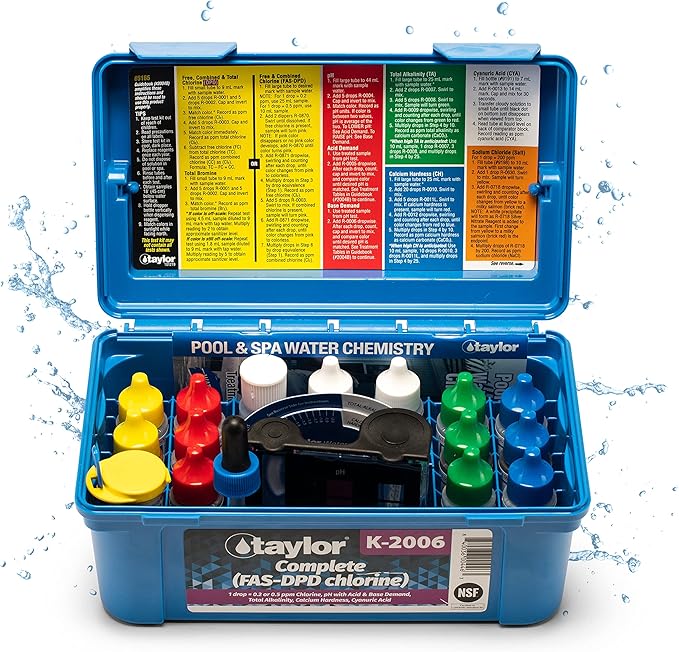
Once chlorine drops below 5 ppm (usually 24 to 48 hours after shocking), test the full chemistry panel: free chlorine, pH, total alkalinity, cyanuric acid (stabilizer), and calcium hardness. Use the pool chemical calculator to find the exact dose of each chemical needed to hit your targets.
Target ranges for opening
Always adjust in this order: alkalinity first, then pH, then anything else. Alkalinity is the buffer that makes pH stable — if it's off, pH corrections won't hold. Add each chemical separately, run the pump for at least an hour, then test again before adding the next one.
If your CYA is zero after opening (common if you didn't add stabilizer at closing), add cyanuric acid to bring it to 30 to 50 ppm. Without CYA, sunlight destroys chlorine so fast you'll be dosing every day. Add CYA through a skimmer sock or pre-dissolve it partially — it's slow to dissolve and can take 24 to 48 hours to register on a test.
Run the filter and check everything
Run the filter continuously for the first 48 to 72 hours after opening. The filter is doing the heavy work of clearing dead algae, sediment, and suspended particles from the water. Backwash or clean the filter more frequently than usual during this period — a clogged filter can't clear the water.
Check the pump basket and skimmer basket daily for the first week. Debris loosened from the walls and floor collects there quickly when the water is still clearing. A full basket restricts flow and makes the pump work harder.
Test the water every day for the first week, then every two to three days once it stabilizes. It takes several days for chemistry to settle after opening, and small adjustments early prevent larger corrections later.
Opening checklist
- Pump water off cover, remove cover, clean and store it
- Pull winterizing plugs from skimmers and return jets
- Reinstall drain plugs in pump, filter, and heater
- Reinstall equipment, check O-rings and gaskets
- Top off water to mid-skimmer level
- Prime pump, start system, check for leaks
- Note baseline filter pressure
- Brush walls and floor, skim debris, vacuum to waste if needed
- Shock at dusk — 1 lb cal-hypo per 10,000 gal (more for green water)
- Run pump continuously for 24–48 hours
- Once chlorine drops below 5 ppm, test full chemistry panel
- Balance in order: alkalinity → pH → CYA → calcium hardness
- Test daily for the first week, then every 2–3 days